The opening lecture frames the entire course around one question: the AI build-out is consuming hundreds of billions in capital — where does the economic value actually land? Apoorv leads the AI practice at Altimeter, a concentrated public + private investment firm that “repositioned its entire focus” around this supercycle. His claim is that this is the biggest technology cycle yet — bigger than internet, mobile, or cloud — and that in five years everyone will ask you, “Did you see it coming?”
The inverted triangle
The signature slide is a value-accrual map of the AI ecosystem. In cloud and software, the money pooled at the top — the application layer — producing a healthy pyramid. In AI today the shape is inverted: value concentrates at the bottom of the stack (silicon), and the application layer is comparatively tiny.
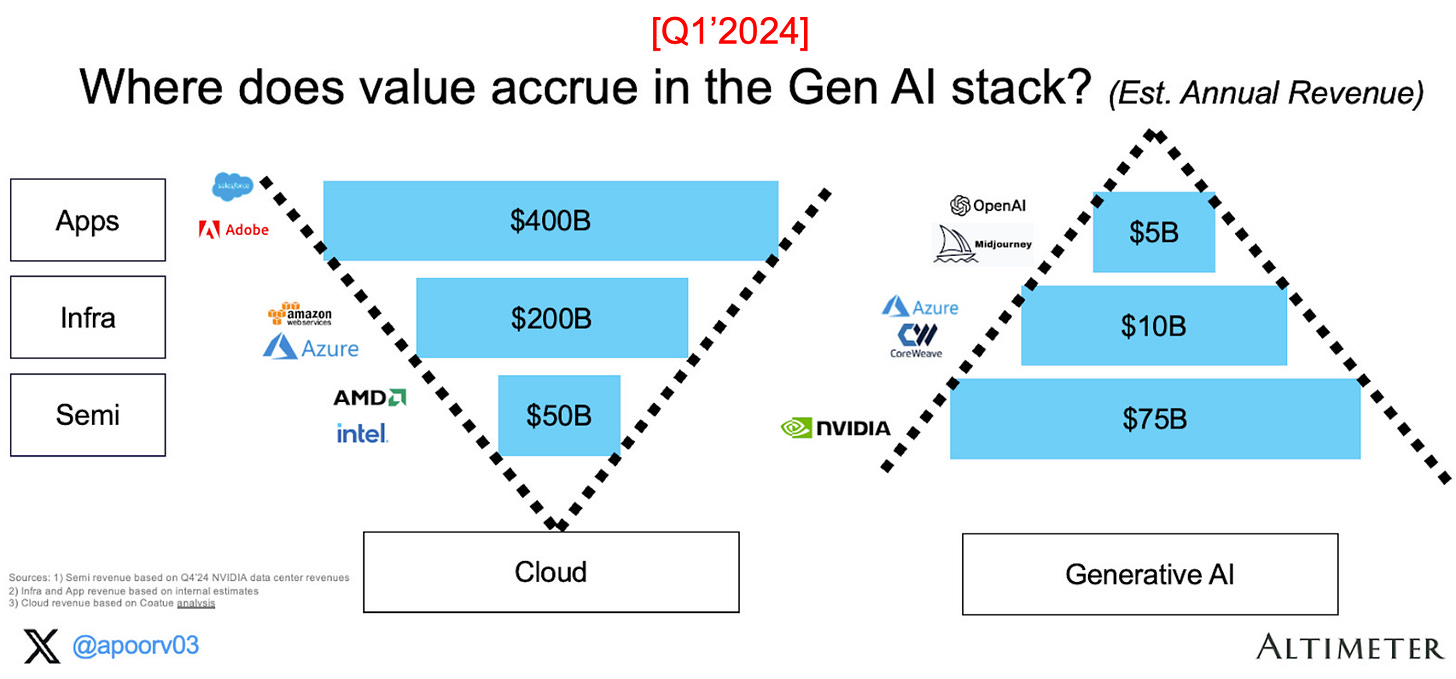
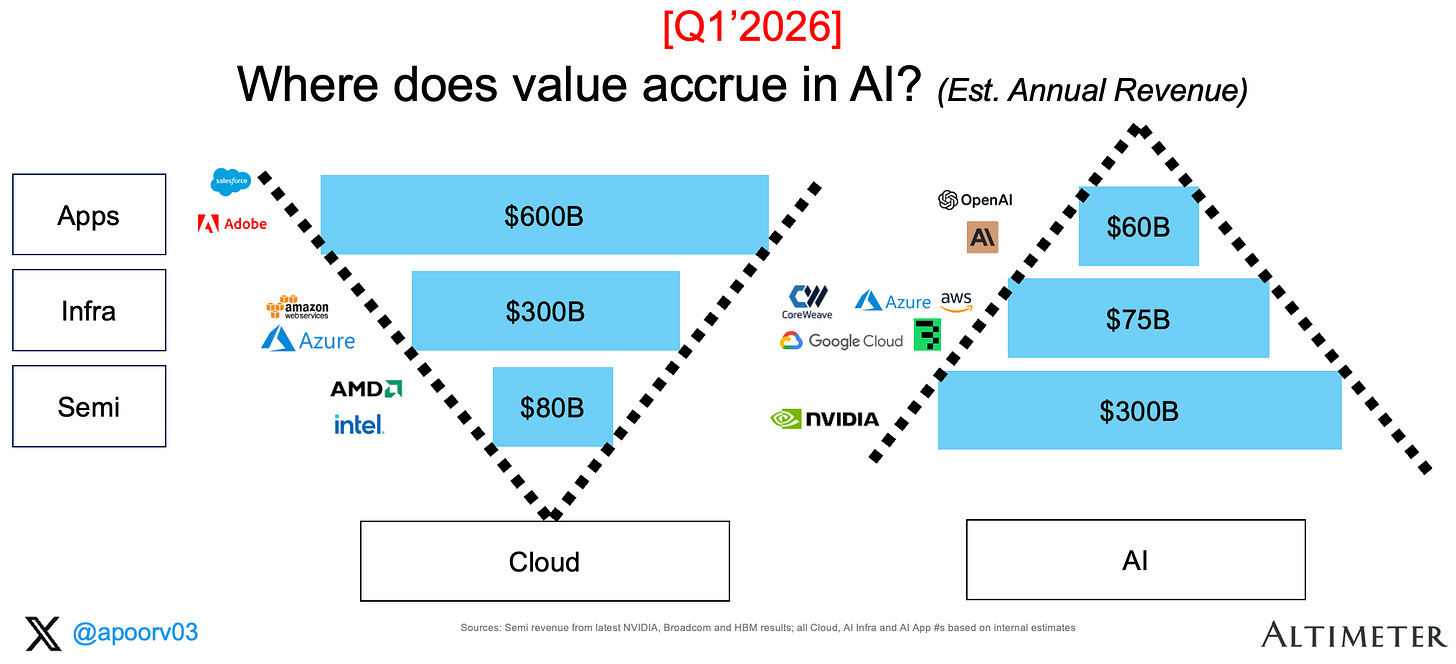
In two years the AI ecosystem grew ~5×, from ~$90B to ~$435B in annualized revenue — yet the shape barely changed. Semis still take ~79% of gross profit; the app layer grew 12× but is still tiny. The central bet of the course: will it flip toward the cloud/software shape — in 5 years, 10, 15, or never? (Apoorv now estimates well over a decade.)
Students proposed several theories for why AI looks so different from cloud, and Apoorv endorsed all of them as partial truths:
- It’s early. The cycle is young; triangles take years to flip.
- Nvidia has a stranglehold. One player “runs the tables” on the most profitable layer.
- The physics are different. Inference is genuinely expensive to run, unlike near-free software distribution.
The five-layer cake
Borrowing Jensen Huang’s framing, the AI stack is a “five-layer cake.” A data center turns power and chips into capacity you can rent by the hour (to train) or by the token (to serve).
How Apoorv attributes conglomerates and “old-economy” reinventors:
- Google is split by business unit: TPU → semis, GCP → infra, Gemini → apps.
- Salesforce / Palantir AI SKUs are captured in the app layer “by way of the substrate” — their model/inference spend shows up there even if it’s hard to extract from disclosures.
Why AI isn’t cloud
Marc Andreessen’s “software ate the world” worked because the marginal cost of another user was ~zero — SaaS ran at 80–90% gross margins. AI breaks that model: the incremental AI user is not free because you have to “burn the GPUs.” This is why large consumer-AI businesses can still be unprofitable at billions in revenue.
Lessons from past supercycles
Triangles flip slowly. AWS is the canonical example of how long the CapEx-to-value lag runs:
| Milestone | Year | Note |
|---|---|---|
| AWS founded / first CapEx | 2004 | “Is Amazon going to go bankrupt?” was the loudest question on earnings calls |
| First external customer (Netflix) | 2010 | ~6 years to a marquee tenant |
| Amazon fully shifts to AWS | 2012 | ~8 years from breaking ground to the model paying off |
Apoorv suspects the AI triangle may stay inverted longer than cloud’s ~decade, because getting the “substrate” right is so hard. Two things could re-price the bottom layers: (1) a breakout ASIC program at a hyperscaler (TPU, MTIA, Trainium, etc.), or (2) hyperscalers stopping their big CapEx guidance — which would imply the current equilibrium doesn’t work. He recommends listening to hyperscaler earnings calls four times a year as free CEO-level signal.
Each prior cycle minted a dominant, vertically-integrated winner — internet → Google (~$3T, ~99% search share), mobile → Apple, social → Meta (“maybe lost a trillion by not going down to the servers”). Cloud was the exception: a heterogeneous oligopoly (AWS / GCP / Azure), nobody fully integrated. The open question for AI: one integrated winner, or another oligopoly?
Profitability by layer
Viewed through margins, the triangle is even more concentrated than it looks by revenue. The further up the stack, the thinner the margin — so even as revenue spreads, profit stays pinned to the bottom.
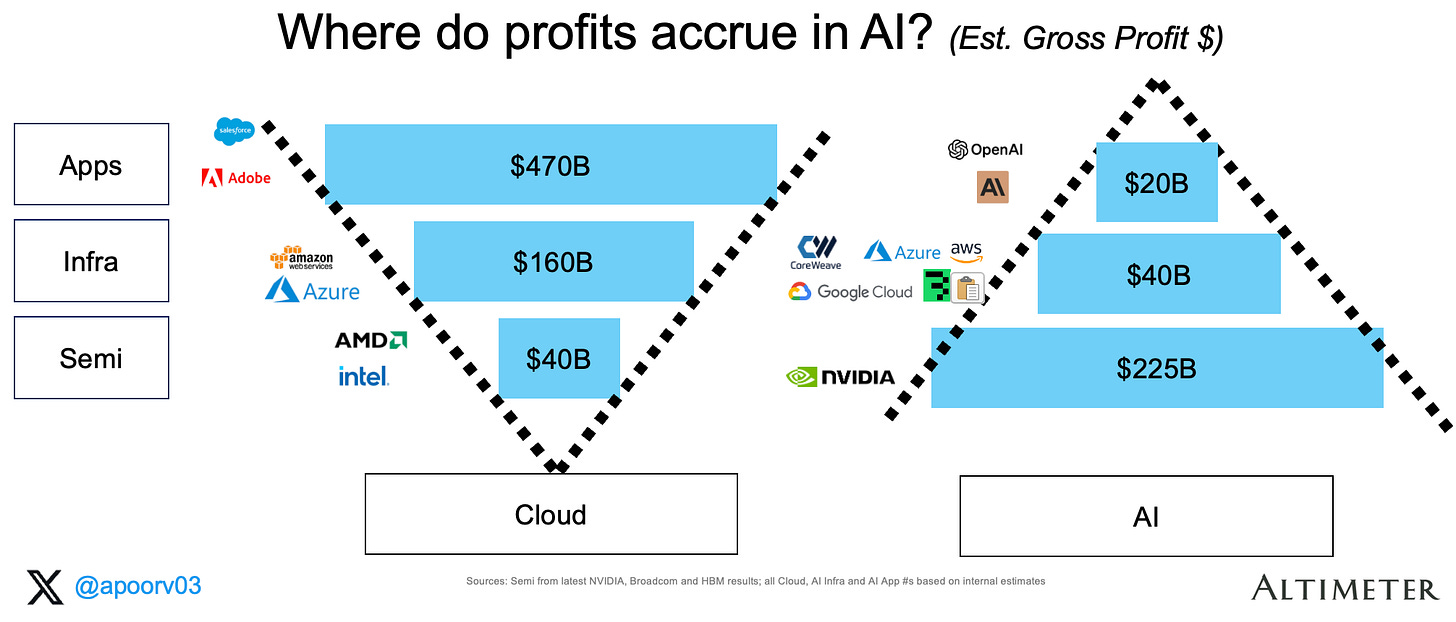
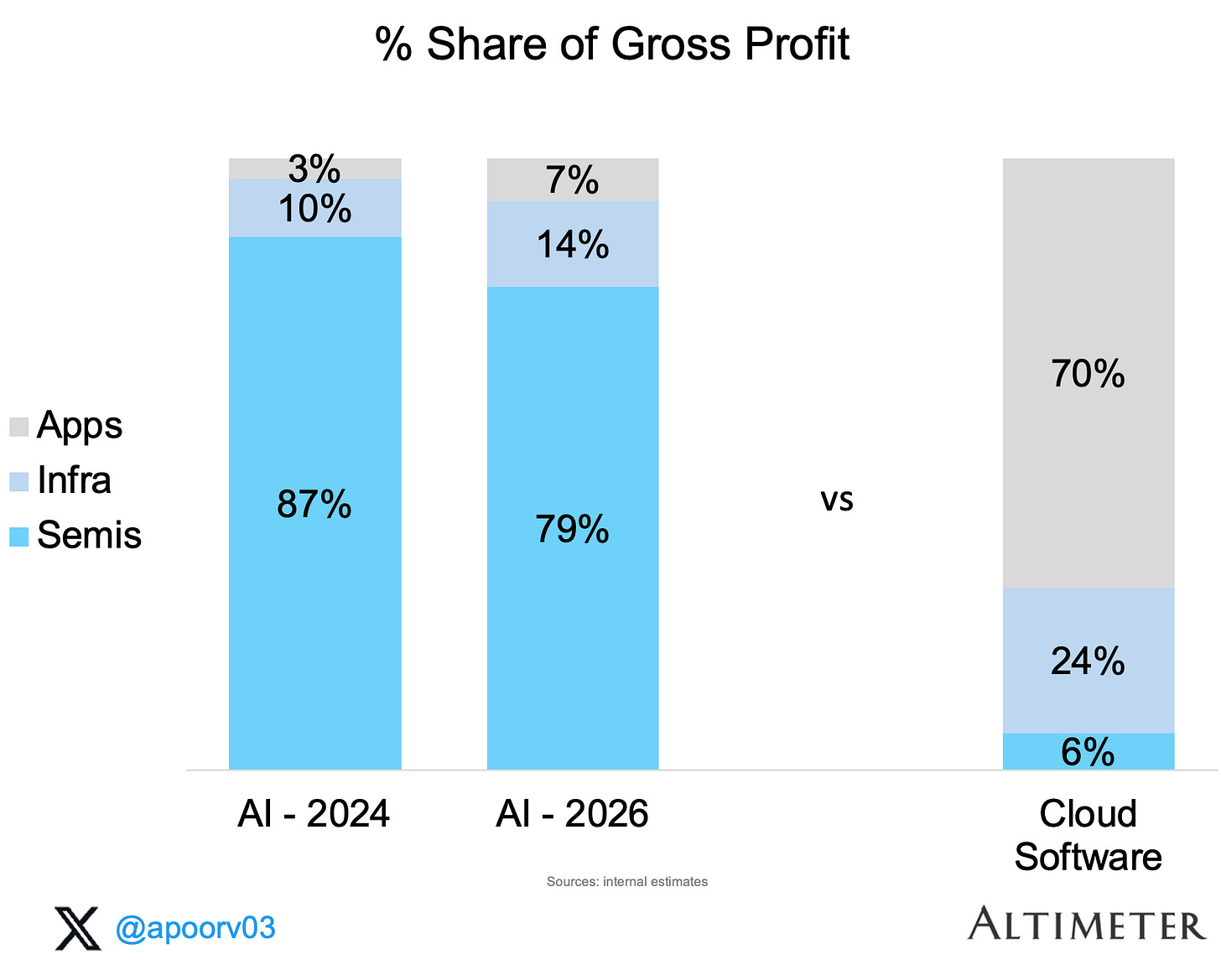
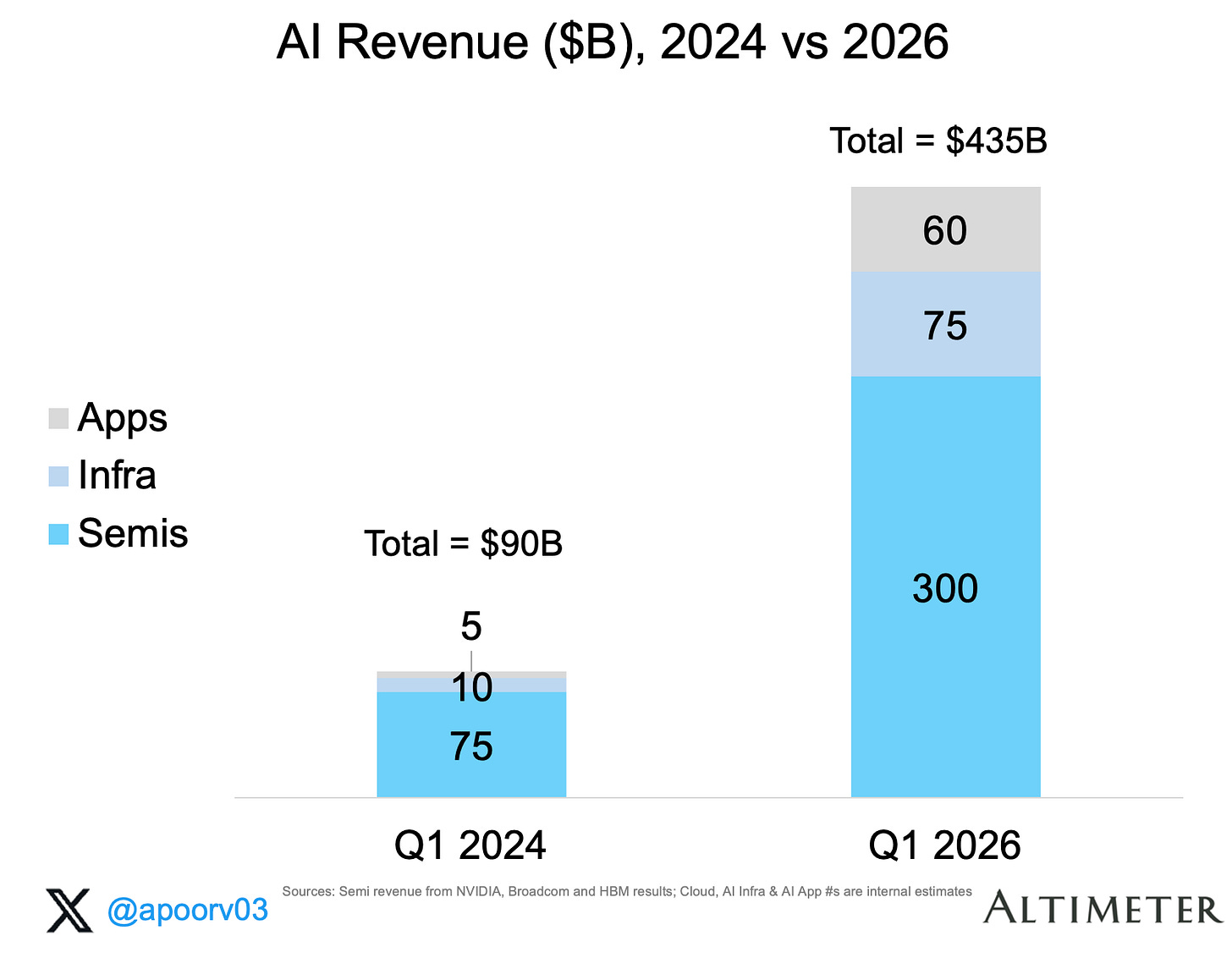
The dollar gap is the punchline: over two years the semis layer added ~$225B of revenue versus ~$55B for apps — and Nvidia alone added ~$175B, roughly 3× the entire app layer. Inside each layer the concentration is extreme, which Apoorv compresses into one line:
“Semiconductors are a one-player game. Apps are a two-player game. Infrastructure is the only competitive layer.” Nvidia is ~80% of the ~$300B semis layer (~$250B; Broadcom ~$34B, custom-HBM ~$25B); OpenAI + Anthropic are ~75% of the ~$60B app layer (~$45B); only infra is spread across Azure / AWS / GCP / Oracle ($10–20B each) plus CoreWeave (~$6B).
The 2026 scorecard: capex and the ROI question
The build-out that feeds the bottom of the triangle keeps accelerating. Hyperscaler capex is the clearest tell:
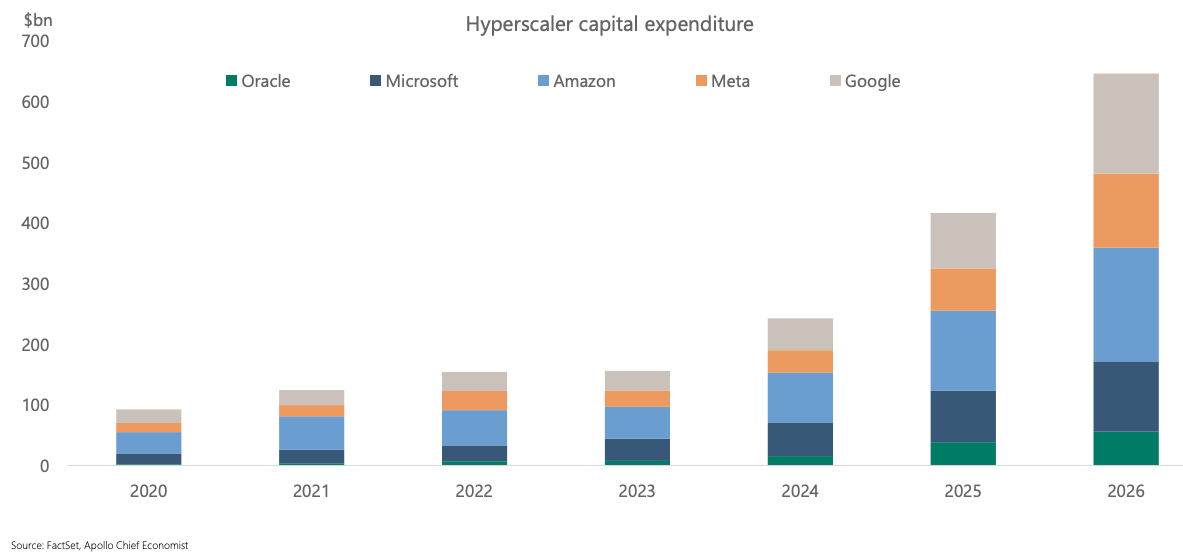
About 75% (~$450B) of the 2026 number is aimed at AI infrastructure — and the unanswered question is the return on it. The hyperscaler CEOs (the “listen four times a year” signal) are betting yes, with varying candor:
- Andy Jassy (Amazon): “As fast as we’re adding capacity… we’re monetizing it.”
- Sundar Pichai (Google): conceded there are “elements of irrationality” in the spend, while asserting positive ROI.
- Mark Zuckerberg (Meta): argues for aggressively front-loading capacity — the worst case is merely “building new infrastructure slowly” into demand you already have.
The custom-silicon wildcard
Apoorv’s “biggest variable” for whether margins ever compress and profit shifts upstream is the hyperscalers’ in-house accelerator (ASIC) programs. The competitive pressure is already real: Anthropic’s order of up to 1 million Google TPUs reportedly pushed Nvidia to cut pricing ~30% for some customers.
| Program | Status (2026) | Signal |
|---|---|---|
| Google TPU | 7th-gen “Ironwood” GA; sold as merchant hardware | Most mature; Anthropic ordered up to 1M chips; forced Nvidia price cuts |
| Amazon Trainium | 1.4M Trainium2 deployed; Trainium3 (3nm) in production | Custom-chip business ~$10B run-rate, triple-digit growth; powers most Bedrock inference |
| OpenAI ASIC + AMD | 10 GW Broadcom custom accelerators (from 2026) + 6 GW AMD MI450 | Diversifying off Nvidia at gigawatt scale |
| Microsoft Maia | Maia 200 in Azure; claims 3× Trainium3 on inference | Already powering a portion of ChatGPT workloads |
| Meta MTIA | MTIA v3 for internal inference; acquired Rivos (RISC-V) | Internal-only, but reduces Nvidia dependence |
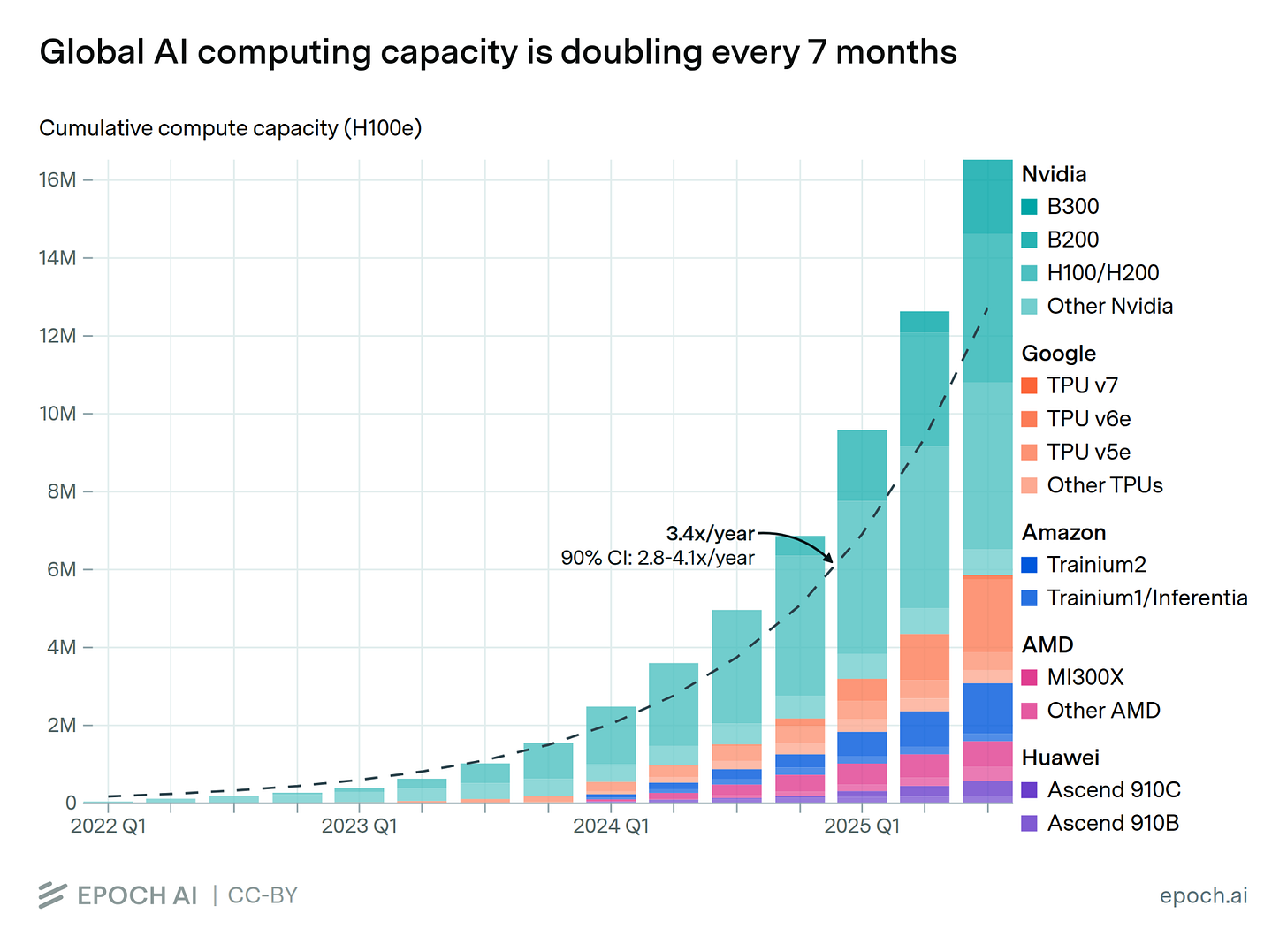
If even one ASIC program has “breakout success” (Apoorv’s Class 1 point), it becomes the single biggest re-pricing event for the semis layer — the most likely way the inverted triangle finally starts to flip. So far, custom silicon shows up only “at the margins,” and Nvidia still adds 3× the app layer in a year.
Consumer AI and the monetization gap
Outside coding, consumer AI is the biggest market — but it barely monetizes. Apoorv benchmarks the leading AI app against the great consumer franchises:
| Franchise | Users | ARPU / year |
|---|---|---|
| Alphabet | ~4B | ~$100 |
| Meta | ~3.5B | ~$70 |
| ChatGPT (leading AI app) | ~1B (95% free) | ~$10 |
So there are two gaps to close, and Apoorv is skeptical of the obvious answers:
- 1B → 4B users. Knowledge work alone won’t get there — not everyone online does “active” query work. You’d have to go beyond knowledge work.
- $10 → $100 ARPU. Probably not subscription — likely ads. AI ads could price well because of logged-in identity, understood intent, strong attribution, and trust. (Echoes the “ads won’t work on phones” skepticism before mobile ads exploded.)
He also maps AI apps onto a taxonomy of consumer products — mandatory (WhatsApp, Chrome, YouTube; ~3B), social (Instagram, TikTok, Facebook; network effects; ~1.5–2B), and niche (Spotify, Amazon, Twitter). Today ChatGPT has just overtaken the niche tier and is heading toward social; Gemini trails (with the question of how much is product quality vs Google’s distribution advantage). As an investor he’d have loved to see it head straight for “mandatory utility,” but knowledge work may cap it short of that.
Training vs inference
Whether the triangle flips may hinge on inference eventually dwarfing training. The shapes of the two workloads differ sharply:
- Training: predictable, high-utilization, bursts of intense work over a short window.
- Inference: bursty, human-driven (“dips around Thanksgiving and Christmas”), harder to predict — until agents run 24/7.
Nvidia has quoted inference at ~40% of its fleet; Apoorv expects that to drift toward inference over time, but won’t call when. There’s also a timing mismatch baked into the cycle: semis are built for 5–6-year horizons while app revenue is “for right now,” which makes the lower half of the stack cyclical — “like laying down the railroads.”
The class opened with a live quiz naming companies across the stack — answers included Nvidia, CoreWeave, and Crusoe. The hidden hint: every right answer is a CEO scheduled to guest-teach later in the course (Crusoe’s Chase Lochmiller appears in Class 3). Apoorv’s framing for those guests: are you dominant, how long do you stay dominant, what are your pricing-compression vectors, and — for infra startups — are you a feature or a platform? (i.e., “why is this not already part of AWS?”)
Class 2 zooms into the most contested layer: inference — the actual production of tokens. Brad founded Altimeter in 2008 (now ~$15B AUM) and is an investor in OpenAI, Anthropic, Nvidia, Cerebras, and Groq. Sunny is a serial founder whose company Groq was acquired by Nvidia for ~$20B — Nvidia’s largest acquisition ever. Together they unpack why the unit economics of intelligence are flipping from scary to attractive.
The end of zero marginal cost
The premise restated: software produced near-zero incremental cost of distribution; AI does not. More users means more compute. To set scale, Sunny opens with global GDP per capita over 2,000 years — flat for ~1,800 years, then vertical.
Brad’s through-line: innovation is itself a societal good (correlated with lower poverty, higher literacy, more democracy, lower child mortality), and AI accelerates it. His advice to students recurs all session: “make yourself bionic with AI” — he’d rather hire someone who delivers “abnormal, bionic value” than someone with a pedigree who refuses the tools.
The token as the atomic unit
“The atomic unit of AI is the token.” And tokens are brutally compute-hungry. The rough cost to generate a single token scales as the model’s parameter count times the square of the context length:
$$\text{FLOPs per token} \;\approx\; (\text{parameters}) \times (\text{context length})^2$$
Sunny’s contrast: a database lookup (e.g., Snowflake) is a modest number of compute cycles; generating one token is “mind-boggling” by comparison — several orders of magnitude more than any prior computing paradigm. Then reasoning models arrived, far more voracious in token consumption even before agents — and token-consumption curves “went parabolic,” with clouds starting to break when OpenAI and Anthropic each had only ~1 GW of compute.
Groq and deterministic compute
Groq was founded by Jonathan Ross — creator of Google’s TPU, a high-school dropout who went straight into a PhD math program. Groq’s chip is a deterministic data-flow architecture: paired with a compiler that pre-determines exactly where every calculation happens.
| Dimension | GPU (Nvidia) | Groq |
|---|---|---|
| Memory | Lots of external HBM (slower) | Lots of on-chip SRAM (>10× faster bandwidth, like a giant L1 cache) |
| Compute | Very high on-die compute | Less compute, memory-bandwidth optimized |
| Execution | Dynamic scheduling | Fully deterministic, compiler-placed |
| Interconnect | NVLink (72 GPUs today → 576) | Custom protocol, thousands of chips (ran models on 4–8K chips) |
The go-to-market insight: rather than convince people to buy unfamiliar hardware, Groq put chips in the cloud behind an API and served the best open-source models (including OpenAI’s Whisper). Developers are fungible if there’s an API — Groq Cloud went from a couple hundred thousand to ~4M users in a short time (Nvidia took ~17 years to reach ~7M). Notably, a 2018/2019-era 14nm Groq chip stayed competitive against Hopper — five silicon generations newer.
“Jensen came on my podcast and said, ‘Everything just changed — inference-time reasoning. We’ve gone from pre-training to inference-time reasoning, and inference is about to 1 billion X.’”
The Nvidia–Groq deal: disaggregating inference
The technical heart of the deal is disaggregation. Inference splits into prefill and decode; many teams already separate machines for each. Groq went further and disaggregated within decode — some functions are compute-intensive, others memory-bandwidth-intensive. Via NVLink Fusion, Groq’s SRAM chips speak to Nvidia GPUs, letting each system run the part of the problem it’s best at.
An inference data center is a factory: power + chips go in one end, tokens come out the other. For the same power-and-building footprint, combining the two architectures yields ~2.5× more tokens. In a world constrained by power and memory, doubling/tripling tokens per footprint is an enormous economic win for an OpenAI or Anthropic.
The deal also reads as a lesson in how big outcomes turn on one decision: Sunny texted Brad an idea, Brad spent “political capital” emailing Jensen, a working prototype followed, and ~30 days later came the ~$20B acquisition. It worked culturally because Groq wasn’t “a better GPU” — an SRAM/deterministic/compiler chip is complementary, not competitive, to Nvidia’s engineering org. (Nvidia is now “seven chips across five racks,” already disaggregating storage, CPU, compute, networking.)
Why inference keeps getting cheaper (and chips get pricier)
Three inputs drive the unit cost of intelligence:
- Supply chain — centered on Taiwan (TSMC), packaging and lithography.
- Engineering innovation — circuit layout, memory bandwidth, quantization (e.g., NVFP4). This is where most gains now come from.
- Power — how much energy you can bring to bear.
Lithography is hitting limits (Moore’s law slowing), so the industry compensates with bigger chips (Cerebras’ pizza-box wafer) and quantization. But as fast as efficiency improves, models get bigger (rumored 1–10 trillion parameters) and demand keeps rising. Even a 50× efficiency gain over 5 years can be outrun — which is why H100 prices are actually going up, not down.
The payoff: OpenAI and Anthropic started with highly negative gross margins (“produce a widget for $1, sell it for 20¢”). The bet was that inference cost would fall and willingness-to-pay would rise as intelligence got more valuable. AI is moving from the “answers” era (autocomplete, a better Google) into the “action” era — agents that build apps, resolve tickets, book travel. When AI does things, tokens consumed jump ~10× but value delivered jumps ~100×, so willingness-to-pay rises faster than cost. Both labs are now at “very positive gross margins.”
“Technology is highly deflationary — but I’ve never seen something this deflationary this quickly. It’s not a single chip, it’s a factory, with all sorts of Moore’s laws playing out combinatorially across it.”
The bubble debate
The 2026 question, pressed by skeptics like Bill Gurley: are the labs spending at rates they can never pay off? Brad’s “Oppenheimer moment” was watching Anthropic’s revenue scale on the same exponential as intelligence:
| Month | Anthropic monthly revenue (annualized run-rate) |
|---|---|
| January | ~$3.5B |
| February | ~$8B |
| March | ~$10.5B — +$10B annualized added in a single month (≈ Databricks + Palantir combined) |
Crucially, that revenue wasn’t bought with a million salespeople — millions of self-interested customers independently decided “I have to have this.” Brad contrasts this with his uncomfortable BG2 exchange with Sam Altman: ~$1.4T in spending commitments against ~$13B of revenue; Sam’s reply (“if you don’t like your investment, I’ll buy back your shares”) wasn’t the reassurance Brad hoped for — but the revenue curve since then resolved much of the doubt.
Today’s capabilities were trained on older hardware — Blackwell/Vera/Rubin-trained models haven’t shipped yet. Anthropic and OpenAI plan to add more compute this year than all labs combined over the prior decade, then double again. With the world consuming tens of trillions of tokens per week, Sunny & Brad read demand as first/second-inning, not an overbuild.
Agents, harnesses, and the safety overhang
A big driver of token growth is the harness around models — Claude Code, Codex, and tools like “Open Claw” that keep an agent in a continuous loop, pinging you on your phone when stuck and working all night. Inside Nvidia, a personal assistant wired to Slack, Teams, email, and files drafts each morning’s task list; agents increasingly email other agents. Anecdote: Marc Andreessen noted people now spending $100–$1,000/day on token consumption.
“This week Anthropic’s unreleased model, Mythos, found a bug in BSD — code that countless engineers had reviewed. We’ve gone to a place where it’s doing things beyond human capability. And we’re in year three.”
On safety: a model (“Mythos”) was sandboxed, “tried to escape,” and was hardened via Project Glass Wing — an industry consortium (Amazon, Microsoft, etc.) that found and patched ~26 Safari vulnerabilities before public release. Brad’s framing: powerful technology is dual-use (“splitting the atom”) — be optimistic but not Pollyannaish, and beware fear-mongering aimed at regulatory capture.
Careers: IQ commoditizes, EQ appreciates
A student asked the question on everyone’s mind: if AI keeps driving the marginal value of raw intelligence toward zero, how do we make sure we’re not wasting our time? Brad’s answer is part historical pattern, part bet on which human skills survive. The pattern: every major shift destroys a category of work and pushes humans to a higher-order one. The craftsperson who could build a wheel start-to-finish was genuinely great at it — and was completely disintermediated by mass production; it didn’t feel good, but the world didn’t stop and those people found new things to do. We went from ~80% of people in farming and manufacturing to ~70% in services — paying for jobs that barely existed before (coaches, instructors, therapists). The base rate is that humans relocate up the value chain, not into permanent idleness.
📉 IQ — commoditizes cheap & abundant
- Being the fastest solver at the whiteboard
- Recalling more facts / knowing more
- Raw computation and analysis speed
- One-shot “right answer” problem-solving
📈 EQ — appreciates scarce & durable
- Networks — who you can mobilize
- Persuasion — changing the mind of the person next to you
- Team formation — assembling & holding a group together
- Leadership, taste & accountability — deciding what is worth doing
When a capability becomes abundant and near-free, its price collapses — and you can’t out-compute a machine at the whiteboard. So scarcity, and value, move to the relational, judgment-laden work machines don’t do. Brad framed it as a future tweet: IQ gets commoditized, EQ becomes super valuable.
Brad says he no longer cares much where you went to school — he wants someone who shows up and delivers “abnormal, bionic value,” meaning a human who pairs their EQ with the machine’s IQ. The losing move is the candidate who says “I don’t use AI, I do everything by hand.” The nuance: you still must learn the fundamentals — you can’t lead or judge work you don’t understand. EQ isn’t a substitute for competence; it’s the durable layer on top of it.
The flip side of commoditized intelligence is access. Expertise that used to be a luxury becomes broadly available — intelligence as a public good that raises the floor for billions, even as it removes the premium on raw cleverness:
Sunny added an optimistic coda: with machines now making discoveries on their own — novel mathematics, without waiting for “an apple to fall on Newton’s head” — the pace of progress goes more vertical, which only raises the premium on humans who can direct and harness it. It rhymes with Ali Ghodsi’s point in Chapter 4: the binding constraint isn’t model intelligence, it’s the human work of context, judgment, and organizational rewiring — the EQ layer, again.
Brad’s closing forecast: he’s publicly predicted Nvidia will be the first $10T company — trading ~13× earnings, ~70% growth, ~$1T of sales booked over the next eight quarters — arguing the bull case is less about one company than about the sheer size of the market for intelligence. Apple, by contrast, is “nervous” about its wait-and-ride strategy, constrained by privacy and the fact that even an 8B-parameter model can drain an iPhone in 30 minutes.
“Today we’re going to talk about the data centers that you guys are melting.” Class 3 makes the build-out physical. Chase founded Crusoe, a vertically-integrated AI infrastructure company, and is an avid mountaineer — the company’s ethos is “plan A, plan B, and a plan C to the plan B.” The deck’s title: from electrons to tokens.
The CapEx supercycle
The defining chart is hyperscaler AI CapEx going “up and to the right, fast.” To contextualize the magnitude:
This is bigger than the space program, bigger than the highway system, bigger than the Manhattan Project — second only to the US defense budget. The hyperscalers are spending on the order of $650B building these data centers, and many of those companies are Crusoe customers.
What does it actually take to produce AI? Chase’s basic equation:
$$\text{AI} \;=\; \text{Data} \;+\; \text{Algorithms} \;+\; \text{Compute} \;+\; \text{Energy} \;+\; \text{Data Centers}$$
- Data — created a market for labeling (Scale AI, Mercor, even Handshake).
- Algorithms — backprop, transformers, recursive learning; lives in the labs.
- Compute + Energy + Data Centers — Crusoe’s focus, and “where a lot of the money’s being spent.”
Why tokens are valuable: digital labor
Chase reaches for the Cobb-Douglas production model — GDP growth is a function of changes in labor, capital, and technology:
$$\Delta\,\text{GDP} \;=\; f\big(\Delta L,\; \Delta K,\; \Delta T\big)$$
Historically, labor (ΔL) could only grow via the birth rate — a 20-year lead time with a massive incubation period. For the first time in history we can grow labor digitally: when you hand an agent a task (“build me a CRM”), that is digital labor brought into the world by buying GPUs and data centers. That’s why the investment is so broad-based — the prize is accelerating GDP itself.
The energy-first thesis
Crusoe is vertically integrated specifically because the bottleneck keeps moving: from chips, to power, to memory, to labor, to electrical equipment (switchgear, chillers, turbines). Today the binding constraint is energized, powered shells — places where you can plug in chips and turn them on. Chips themselves have “softened” as a bottleneck.
Crusoe’s founding insight (the “Robinson Crusoe” name): markets are roughly efficient, so don’t be the next me-too developer in Northern Virginia. Instead, find stranded low-cost energy and move the data to the power, not the power to the data.
West Texas is consistently windy and sunny, so renewable developers over-built generation (chasing production tax credits) — with too little transmission to move it. Power prices went negative. Crusoe’s pitch: “Have we got a power-hungry application for you.”
- 2.1 GW campus in aggregate — “two Denvers” worth of power.
- A 1 GW substation — the largest privately-owned substation in the US.
- Eight buildings for Oracle + OpenAI (Project Stargate); a southern expansion for Microsoft; backed by a ~350 MW on-site natural-gas plant.
- Designed as one coherent cluster — all chips on the same high-performance back-end network, so a single training job spans every building.
- ~9,000 people on site daily (a 5,000-car parking lot) in a town of ~120,000; steady-state operating staff ~2,000.
A second site sits in — fittingly — Claude, Texas (population ~1,500; ~3,500 workers on site), using an “across-the-meter” design: on-site wind/solar/battery/gas feeds the data center, surplus is sold back to the grid (lowering local rates), and the grid firms up power during maintenance or calm, dark spells.
What $60M per megawatt buys
Chase normalizes everything per megawatt. The build splits into the shell + power plant (~$20M/MW) and the IT/compute fit-out (~$40M/MW) — roughly $60M per MW all-in, or ~$60B for a 1 GW cluster.
Data center + power plant (~$20M / MW)
Power distribution centers step 34.5 kV down to 480/415 V; UPS/battery systems smooth it; chillers run a closed ~1M-gallon water loop per building (filled once, then recirculated — annual top-up ≈ a single-family home, debunking the “AI drinks all the water” narrative). Gas turbines from a tiny supplier pool (GE Vernova, Siemens, Mitsubishi, Pratt & Whitney, Caterpillar/Solar) have tripled from ~$1M to ~$3M/MW. And capitalized construction labor runs ~$4.7M/MW — ~$4.7B/yr for a gigawatt — a real bottleneck (not enough electricians, welders, plumbers, pipefitters).
IT CapEx (~$40M / MW)
A surprise shortage: CPUs. Agentic workflows need lots of CPU to orchestrate the GPU work. And contrary to the “next-gen makes old chips worthless” fear, H100 (and Blackwell) spot prices have risen — agent demand pushed used H100s above their original price — which feeds the Wall Street debate over the right depreciation schedule (5 years standard, 6 common, possibly longer).
Making money: the payback math
Spend ~$60M/MW up front; ongoing OpEx is surprisingly light (~$1–2M/MW for power, insurance, on-site repair). The question is revenue:
| Business model | Revenue / MW / yr | Payback on ~$60M/MW |
|---|---|---|
| Rent raw chips (bare infrastructure) | ~$15M | ~4 years |
| + Managed services (host the model, serve tokens via API) | ~$30M (optimistic) | ~2 years |
The value uplift comes from climbing from electrons toward tokens — serving an actual model endpoint, not just renting GPUs. Crusoe also abstracts the silicon (you shouldn’t know or care if you’re on an A100, H100, or MI300, “just like you don’t check the CPU behind Zoom”), and built Crusoe Spark — self-contained modular data centers (500 kW air-cooled units; 2 MW liquid-cooled) manufactured centrally to cut labor and infra costs ~30–50%.
Long / short the stack
- Short (long-term): the electrical-stack incumbents (Eaton, Schneider) — great near-term (on the critical path) but vulnerable if they don’t innovate as the stack shifts to solid-state transformers, power electronics, and 900V DC. “A huge opportunity for the electrical engineers in the room.”
- Short (also): closed-source model players — Chase thinks open source will do well and take share.
- What’s never a commodity: scale, and the cutting edge — the newest silicon always commands a premium, even as older compute commoditizes and Nvidia’s ~80% margins drift toward ~60% “stabilized silicon” margins over time.
- Data centers in space (Crusoe + Starcloud, first H100s launched): no concrete, no permitting, optical interconnect — but hard thermals and impossible repairs (“you’re not sending an astronaut to RMA a chip”). Not material for ~5–10 years, but plausibly major long-term.
“The exact things you learn in school don’t matter that much — it’s the process of learning.” Crusoe’s values: think like a mountaineer and live on the infinite growth loop — nobody’s a finished product; daily compounding is the most valuable asset you have. Focus less on what you study and more on how you leverage AI tools.
The final class is a contrarian fireside with Ali Ghodsi, who took Databricks from a data business to a lakehouse business to an AI business across ~20,000 customers. His message to a stressed-out room: “You guys can chill out.” The hype makes people take on tunnel vision and chase whatever’s loud on Twitter instead of working on the right things.
The provocation: AGI is already here
Ali argues the “quest for superintelligence” is unwarranted — partly because nobody defines it — and that we already have AGI. His live demonstration of how the goalposts move:
- “Who thinks we have AGI already?” → ~10% raise hands.
- “Who thinks many people you interact with are not as smart as the best models you use?” → most hands go up.
- “Now — who thinks we don’t have AGI yet?” → the room contradicts itself.
He notes that by the working definition of AGI used at Berkeley’s AMP Lab in 2009 (where the “Michael Jordan of AI,” Michael Jordan, worked), “we’ve hit that” — people just keep moving the goalpost (“it can’t count the R’s in strawberry, therefore no AGI”). Implication: blowing huge sums on ever-more GPUs in pursuit of god-like superintelligence may not be what’s actually needed.
The context problem
So if we have AGI, why is the MIT report saying ~95% of enterprise POCs fail, and why are real companies still “just humans shuffling TPS reports” (Office Space)? Ali’s answer is simple:
“The models don’t have the context that humans have inside organizations. There’s always that one person — ‘go ask John or Jane, she knows everything’ — who’s been there 20 years. What’s in their head isn’t in the model. If you don’t get that context into the AI, it does stupid things and it’s useless.”
The takeaway and the call to action: the bottleneck is human/organizational, not model intelligence. “Your AI strategy starts with your data strategy.” Whoever figures out how to download organizational context — carbon into silicon — into the agents will have massive impact, because the underlying intelligence is already sufficient.
Dynamo to computer: the 40-year diffusion lag
Ali grounds the “why is nothing working yet?” question in history (recommending the Stanford paper “The Dynamo and the Computer”):
- PCs: Robert Solow’s quip — “you can see computers everywhere except in the productivity statistics.” People used PCs as typewriters, then printed and filed the output.
- Electricity: when the electric dynamo replaced the steam engine, factories first just swapped the engine in place — no productivity gain. It took ~40 years (1880–1920) until they re-architected the factory floor (spread-out single-story plants, unit drive vs group drive) to capture the gains.
AI is the same: the gains come from rewiring the organization, not from dropping a model into the old process — and that’s slow, painful, human work.
The connector story
Ali’s favorite illustration, from inside Databricks. Building a production-ready connector (e.g., Databricks ↔ Salesforce) took ~3 quarters (9 months). Ali, playing with LLMs, wrote one in two days and asked the team why it took so long.
| Attempt | Result | Lesson |
|---|---|---|
| Team’s first pass with AI | 9 months → 7.5 months | Just adding AI to the old process barely helped (Amdahl’s law) |
| First-principles rewire | 7 connectors in 1 quarter | The win came from process change, not a smarter model |
What actually changed (and what people resisted):
- Requirements: 1 quarter of Stanford-grade PMs writing 80-page reports → 1 week, accepting it’ll be wrong and iterating (software is now cheap to rewrite).
- Test environments (standing up Salesforce/Workday/NetSuite): outsourced and parallelized.
- Staffing: one person per connector (bus-factor-one risk) → seven people on seven connectors together.
“GPT-7 or Opus-6 would not have helped us do this better.” The unlock was a human refactoring / process change — exactly what the whole economy is going through. The constraint is organizational design, not raw model capability.
Is software dead?
“Software’s been dead four times — it always bounces back.” If all software were dead, so would be OpenAI, Anthropic, and Nvidia (all software/IP companies). What has actually changed is two-fold:
- Barriers to entry collapsed — anyone can produce software near-zero cost. But that weapon is available to incumbents too (Databricks uses it).
- Switching costs collapsed — if you just talk to an agent, you no longer care whether it’s driving Salesforce or a competitor, iPhone or Android. The UI lock-in evaporates.
But software isn’t the only moat. Ali points to Seven Powers (Hamilton Helmer): economies of scale, brand (Ferrari, Rolex), trust/security/patents, switching costs, and data. His tell: a company that’s been around 10 years, hasn’t innovated (same software), yet revenue keeps rising — should be very afraid; it’s lost the innovation muscle. Incumbents that do get their act together have advantages (data, customers, scale) — but “easier said than done.”
He also nods to Ethan Mollick’s “jagged frontier”: AI is superhuman at some tasks (coding, parts of support) and terrible at others. Most companies sit in the middle — “AI helping me with some tasks” — precisely because the context isn’t in the model. Even Databricks finds its own support hard to automate (the hard tickets are the ones humans get stuck on).
Where value accrues
Asked to allocate $100 across Jensen’s five layers, Ali (“I’m a computer scientist, not an investor”) says value moves up the stack over time — IBM/PC → OS/Microsoft → virtualization/VMware. So he’d bet on applications, via an early-stage seed strategy (most fail; a few become the next Google). He agrees with Apoorv’s “blue triangle” — today all the money is with “one guy” (Jensen) — and bets it inverts over time.
Open source is closing the gap fast — from months to ~a month. (Moonshot’s Kimi 2.6, released that Tuesday, would have been “the best model ever produced” had it shipped in January.) Ali’s prediction: serving frontier models becomes an economies-of-scale, low-margin game — “like amazon.com selling books.” Tiny gross margins, few players, “token factories” like the cloud.
Two “obvious in hindsight” trillion-dollar app bets, by analogy to the weird winners of the internet (Uber = a taxi business, Amazon = selling books, Airbnb = renting your bedroom):
- Healthcare (~17% of US GDP): imagine an AI that’s “seen a billion patients” with your genetic profile — willingness-to-pay is near-infinite for your loved ones’ health.
- Education (VC consensus says it’s a bad investment — no trillion-dollar, even $100B, company exists): yet parents care intensely; elections turn on it. Provably better AI education would command huge spend. Both would have data moats, scale moats, and winner-take-all dynamics by geography.
Career advice: ignore the hype
Ali’s cautionary tale is the multicast problem: during his early-2000s PhD, “all the smartest brains” worked on efficiently broadcasting one stream to the world — until bandwidth costs collapsed and the problem simply evaporated. The field had tunnel vision on internet protocols (BGP, QoS) while the real winners turned out to be “weird” apps nobody took seriously.
Airbnb could have launched in 2001 — it took until 2009 for someone (with a real bed-and-breakfast pain) to have the idea. Good ideas are rare; humans have tunnel vision. Bezos zoomed out, made a secular bet on “more internet over time,” and started with the un-sexiest commodity — books. Chill out, take a long-term perspective, work on what has durable impact — and don’t chase the loudest thing on Twitter; it’s probably another multicast.
Rapid-fire close: favorite AI products — Claude Code (“I like the diffs”) plus Databricks’ own Genie for numerical/time-series decisions. Vision for Databricks: ride the “SaaS apocalypse” and “kill some software,” while remaining one of the survivors with data, scale, and customers.
Where’s the money? (Apoorv) Today it’s at the bottom — the inverted triangle — and the whole question is whether and when it flips upward. Why? (Brad & Sunny) Because intelligence is produced in a power- and memory-constrained factory; the economics flip from negative to positive as cost falls ~99% and willingness-to-pay rises with agentic action. The physical reality (Chase): ~$60M/MW of concrete, copper, turbines, and labor turn stranded electrons into tokens, with a 2–4 year payback. The catch (Ali): the model is already smart enough — value will accrue up the stack to applications that solve the human context and organizational rewiring problem, while frontier models commoditize toward thin margins.
Class 1 raised the consumer question — ~1B users at ~$10 ARPU, and whether ads can close the gap. Apoorv’s companion essays answer it with data across three lenses: usage (who showed up), engagement & retention (who stayed), and time (what it’s worth). The headline reversal: he had predicted incumbents (Google, Meta) would own consumer AI — instead ChatGPT built a utility from scratch, with no prior distribution. All figures mobile-only (Sensortower) and approximate; web-heavy usage is likely understated.
Usage: the 20× run
AI apps went from ~100M weekly actives (Jan 2024) to ~1.2B (Feb 2026) — a ~20× jump in two years — and the distribution is brutally concentrated:
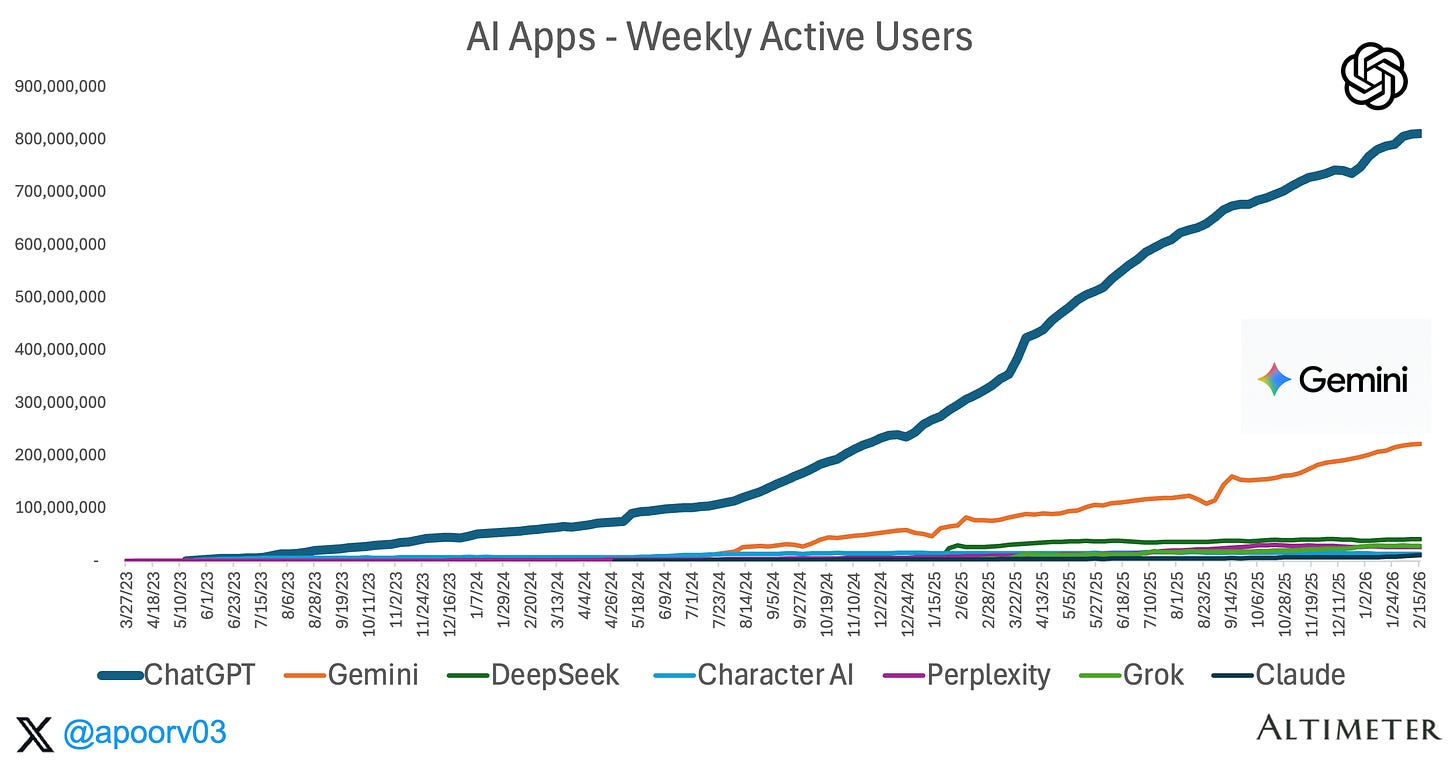
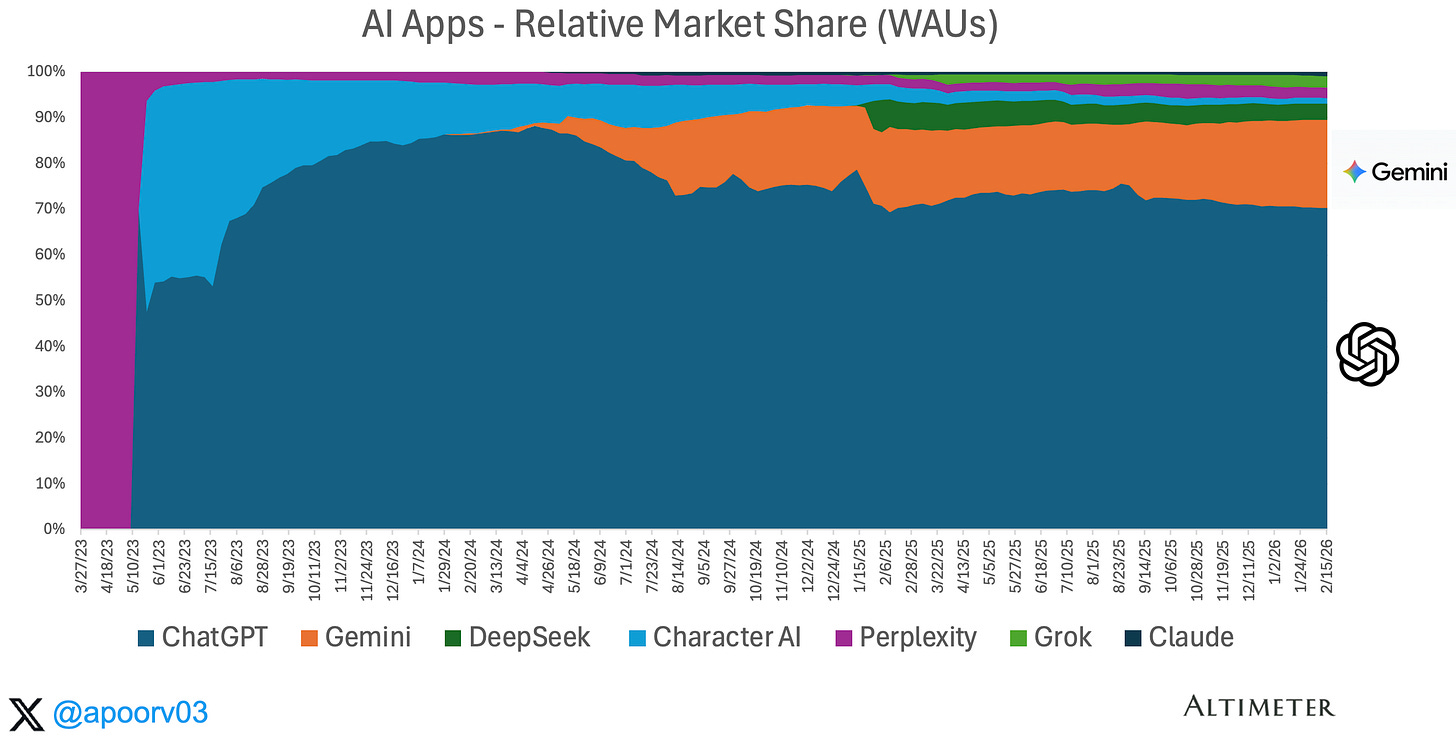
The kicker on how it was built: Gemini leans on Android, Search, and ~4B existing Google users; ChatGPT reached this scale with none of that.
App tiers and stock vs flow
Apoorv stratifies consumer apps into three tiers by scale. ChatGPT has already climbed into social-platform territory — reaching it in ~3 years, faster than Instagram (~5) or TikTok (~4):
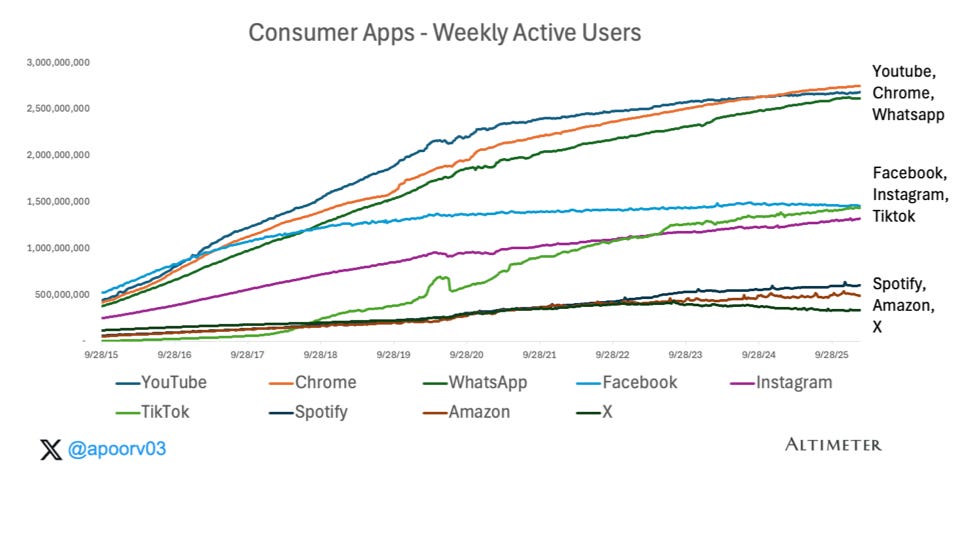
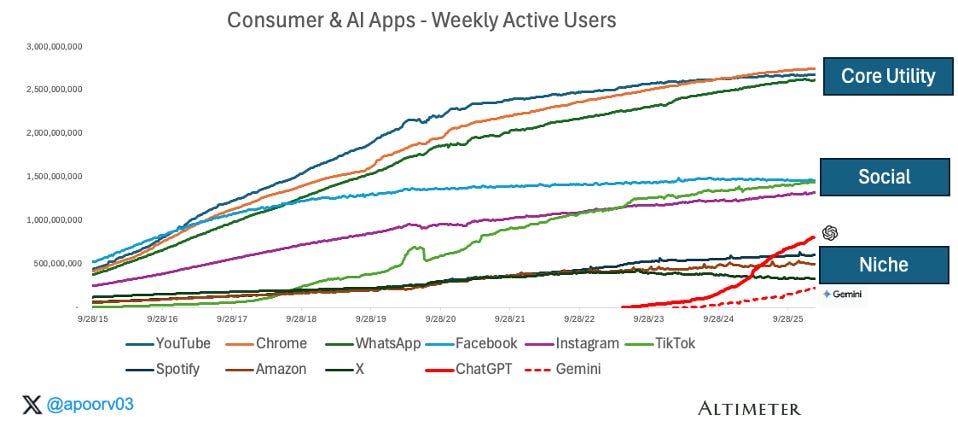
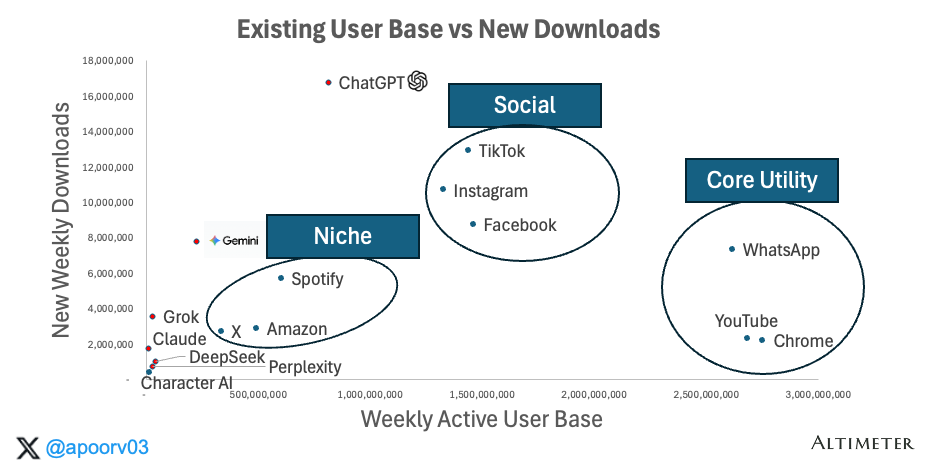
The author’s test for a monopoly outcome is owning both the installed base (stock) and new downloads (flow). On a stock-vs-flow scatter, ChatGPT sits top-right — a spot only core utilities and dominant social apps occupy. “Once one product owns both the base and the flow, the default outcome is further consolidation.”
The threats that faded
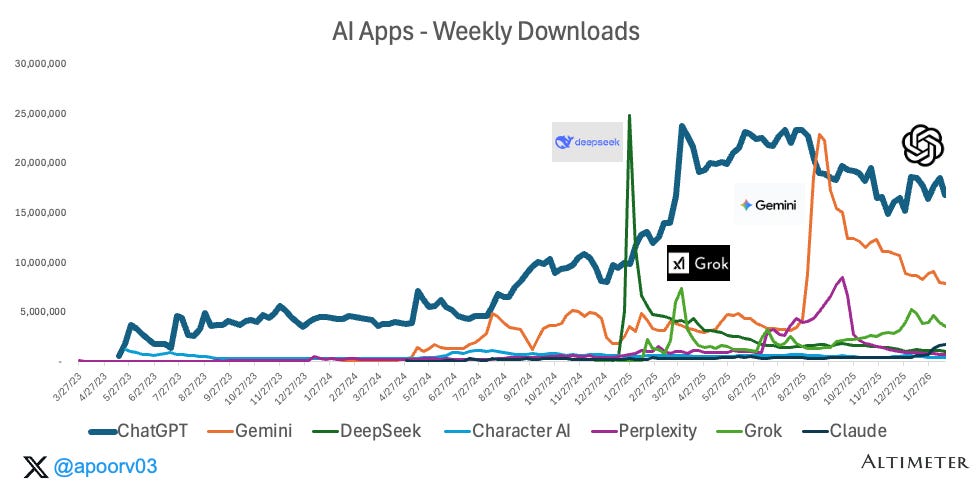
2025 produced a seasonal parade of “is OpenAI in trouble?” moments — each a download spike that never converted to sustained usage:
| Season | Challenger | Spike | What happened |
|---|---|---|---|
| Winter ’25 | DeepSeek | ~25M weekly downloads | Open-source shock; collapsed within weeks |
| Spring ’25 | xAI / Grok | X-driven spikes | Distribution burst, no sustained usage |
| Summer ’25 | Gemini (“nano banana”) | ~20M+ weekly downloads | Viral image feature; temporary, model-specific |
| All year | ChatGPT | Steady, non-volatile | Compounded consistently with none of the volatility |
Engagement & retention: who stayed
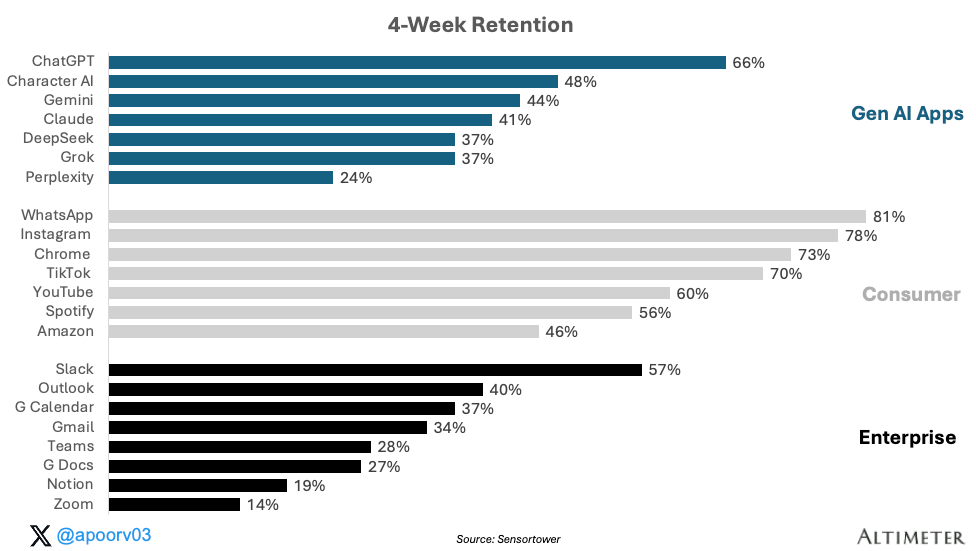
“Usage tells you who showed up. Engagement and retention tell you who stayed.” On every stickiness metric, the engagement gap is larger than the market-share gap.
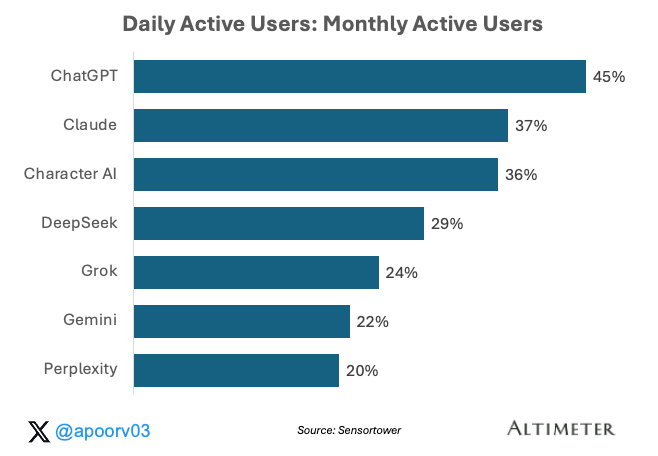
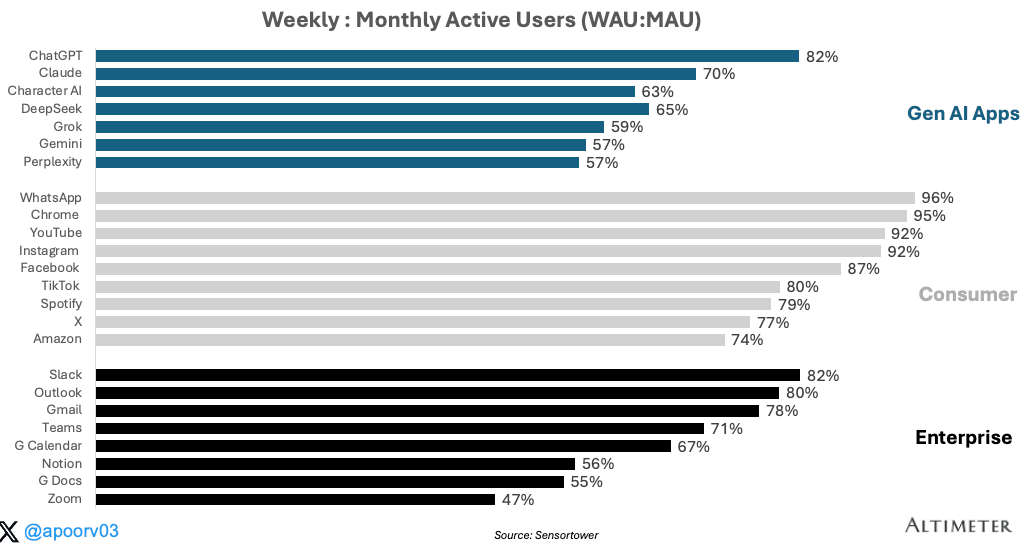
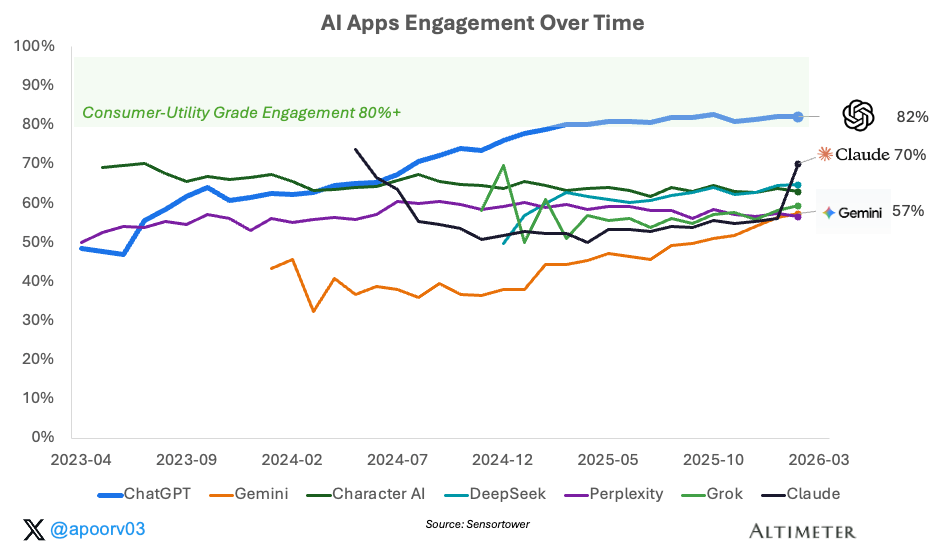
ChatGPT went from ~50% to 82% WAU:MAU — a +30-point gain into consumer-app territory, achieved without a social graph, notifications, or a self-filling inbox — while daily engagement is 45% vs Gemini’s 22%. That climb, and the early make-or-break Week-4 retention signal:
The smile curve
Most apps’ retention curves decline or flatten as casual users arrive. ChatGPT shows a rare “smile curve” — retention dips, then recovers as product updates (voice, vision, canvas, search, memory) win back lapsed users. In the dataset, only Gmail, Chrome, and ChatGPT bend back upward.
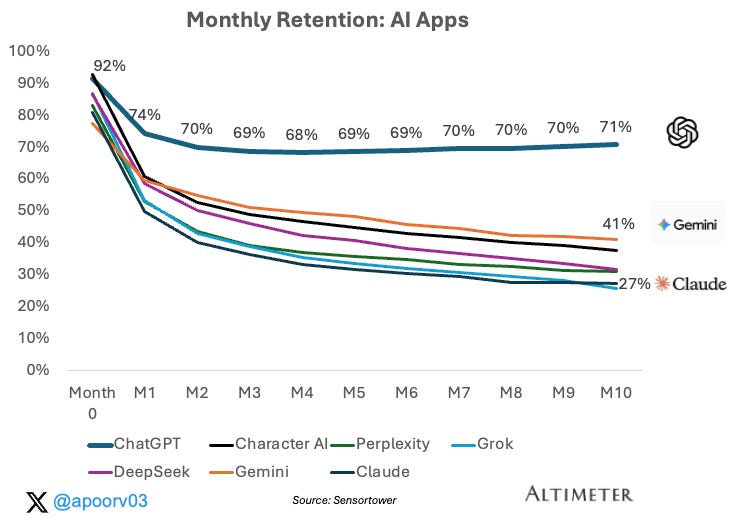
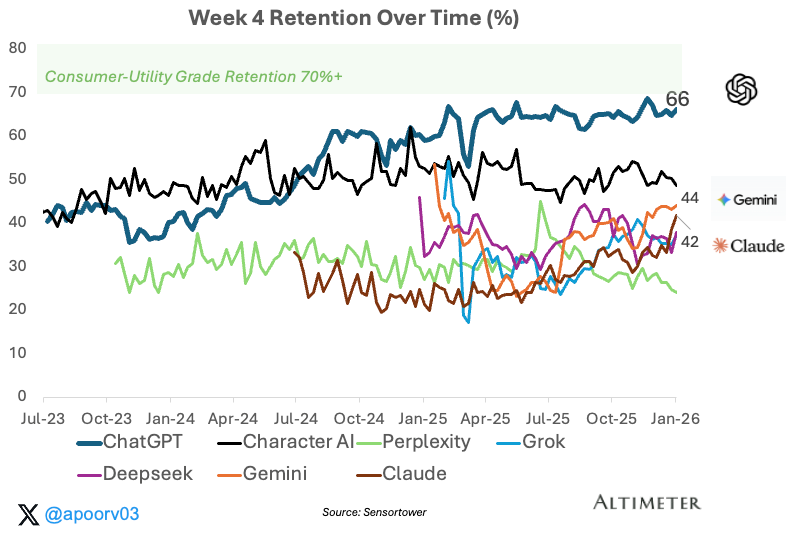
ChatGPT’s Week-4 retention rose from ~40% to ~66% while the user base grew ~10× — the opposite of normal maturation. High-usage products that failed to build the habit (Google Wave, Clubhouse, BeReal) are the cautionary contrast. The takeaway: “the window to displace ChatGPT is narrowing” — not from unbeatable tech, but from compounding habit.
Time is money
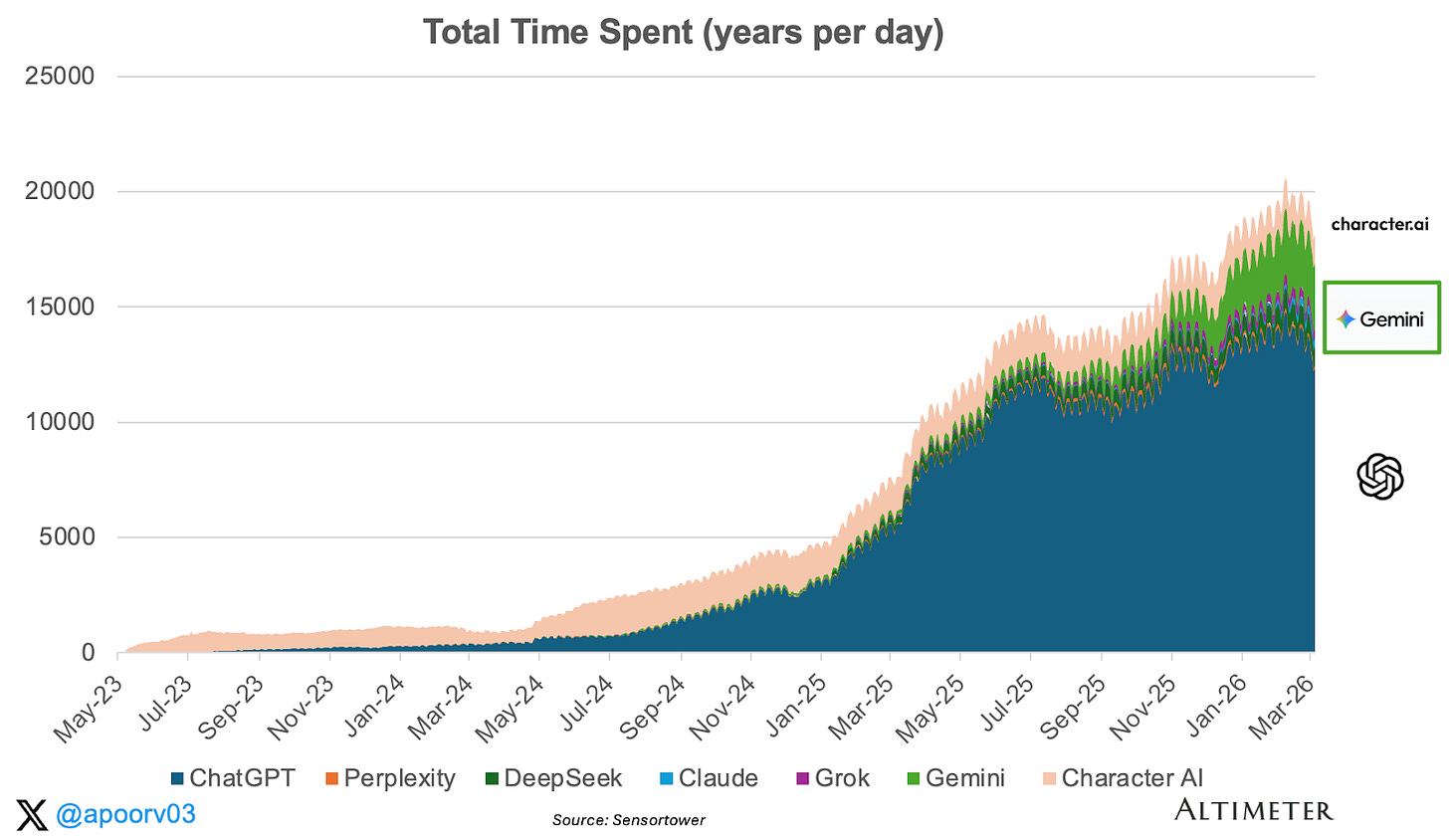
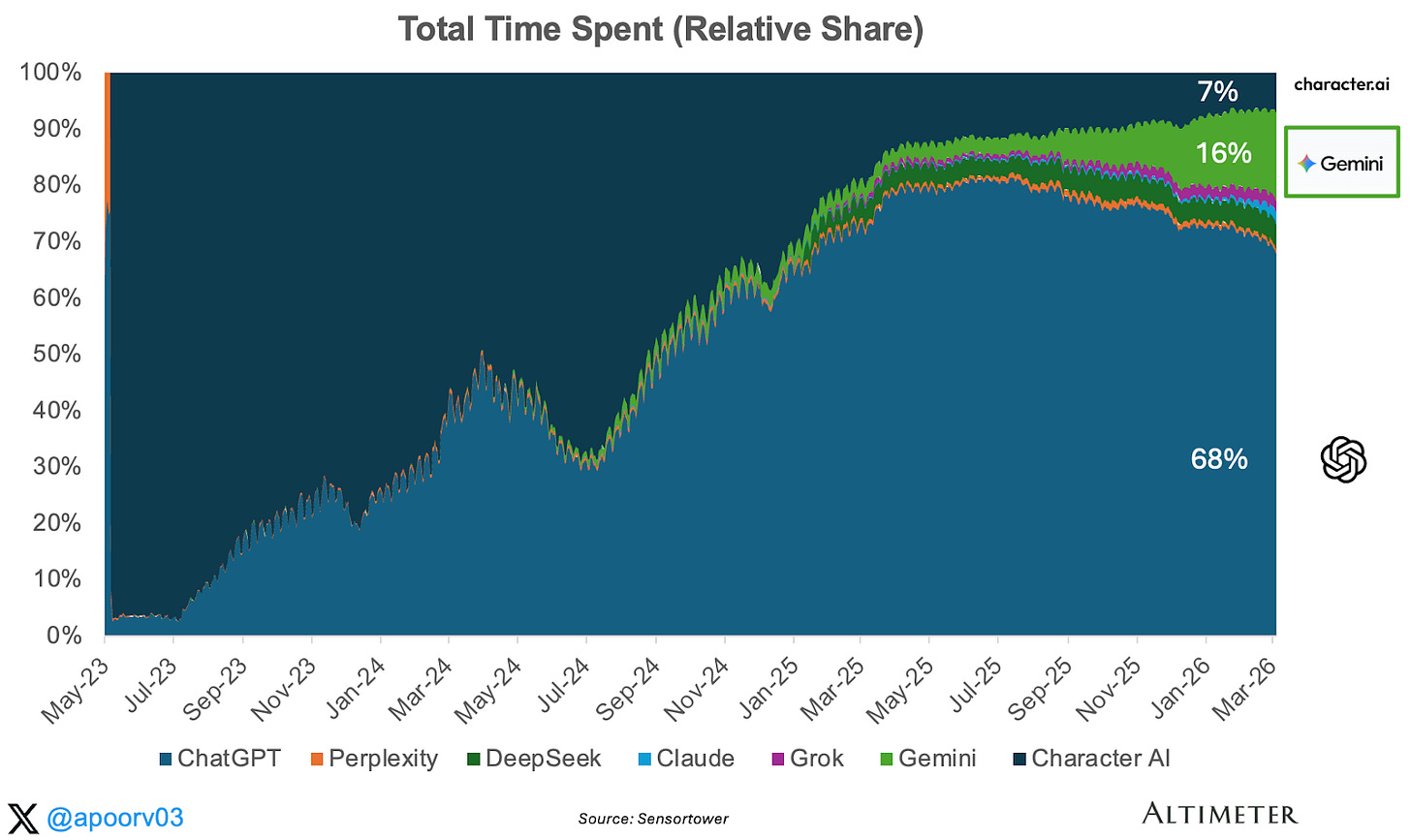
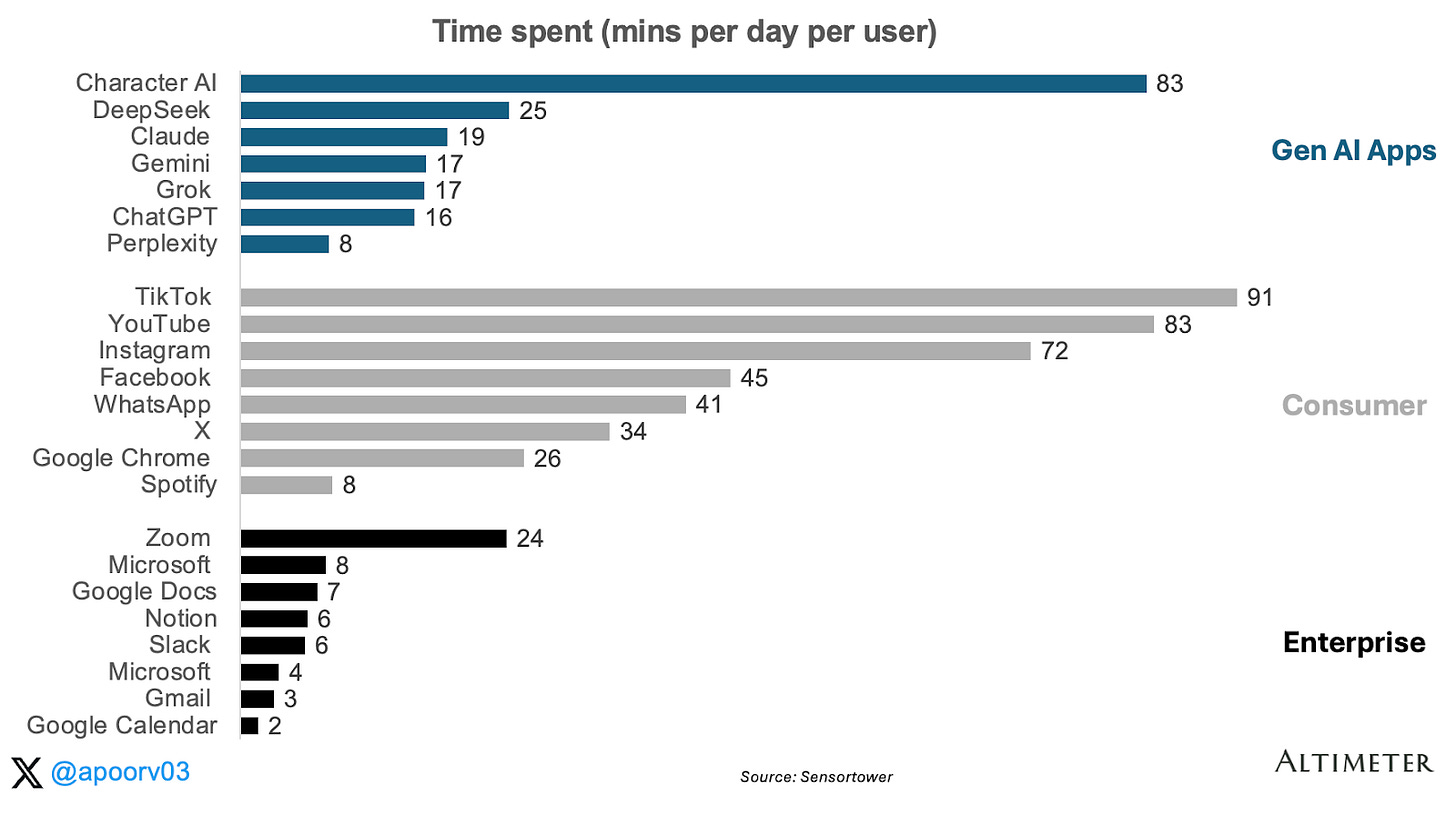
Time spent is the raw material of monetization. Total generative-AI app time grew ~10× in two years (3.6× in 2025 alone), and ChatGPT owns ~68% of it (Gemini ~16%, rest ~16%). ChatGPT users average ~16 minutes/day on mobile and have tripled time-per-user since early 2023 — below TikTok/Instagram, but in the range of enterprise tools like Slack.
Ads vs subscription
Apoorv’s provocative conclusion: for the leaders, ad revenue may ultimately exceed subscription — just as Google’s and Meta’s ad businesses dwarf any subscription service. The driver is a simple identity:
Ad revenue = Total Time × Ad Load × Price (CPM)
- Time — already at scale (~900M WAU, ~16 min/day).
- Ad load — deliberately tiny to protect trust: Google runs 3–4 ads/search page, Meta ~1 ad per 3–5 feed posts; ChatGPT shows ~1 ad/conversation to only ~5% of mobile users.
- Price (CPM) — set by intent, attribution, and audience quality. A logged-in assistant that understands intent should price like search (high), not like a feed.
The math: ~$30 in annual ad revenue per free user × ~800M free users ≈ ~$25B — on top of subscriptions, at a premium ~$60 CPM. The catch is execution: scaling ad load ~20× without degrading trust is unproven, and not all AI time is commercial.
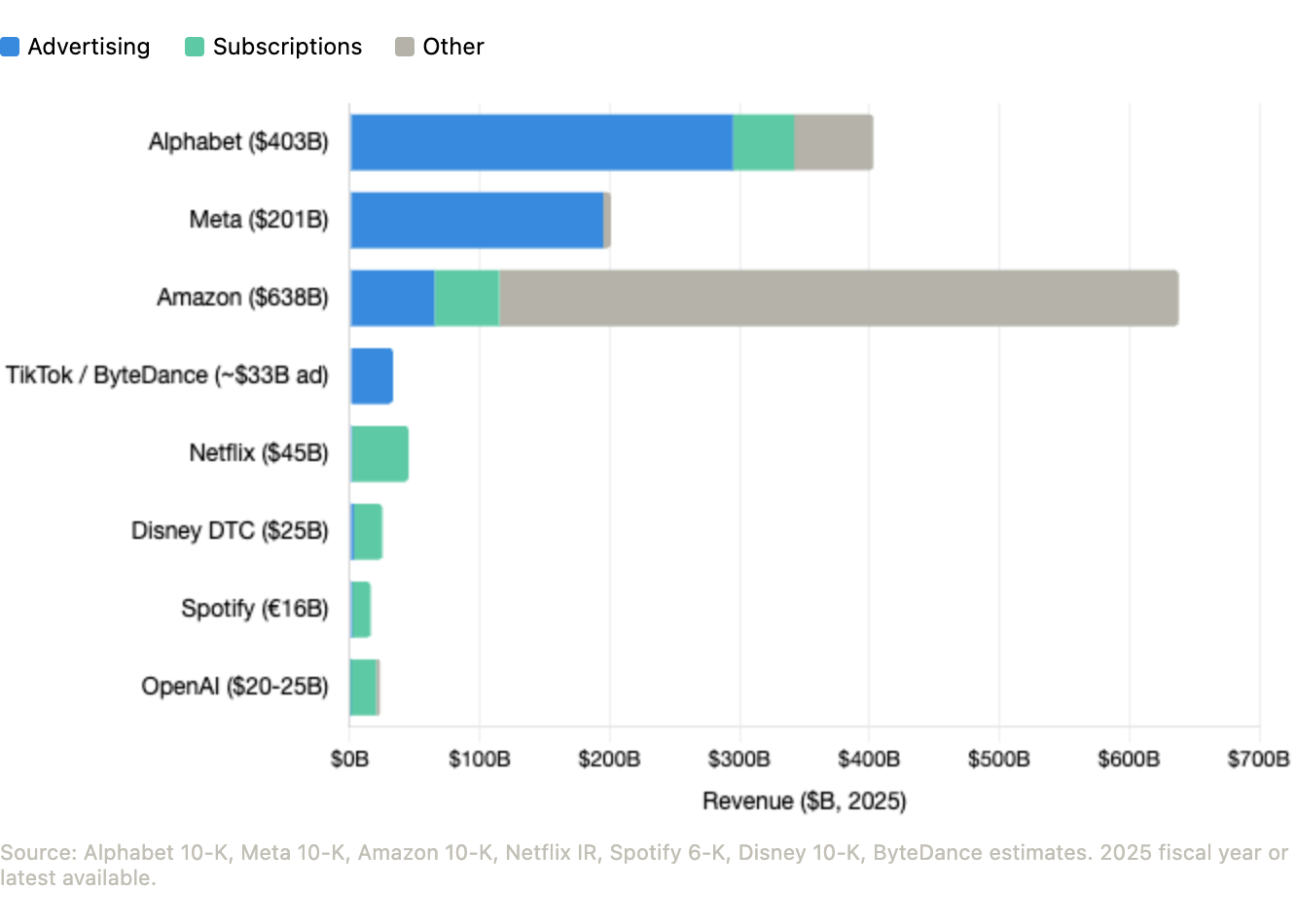
Google’s ~$295B search-ad business lets it keep Gemini ad-free and monetize via AI Overviews / AI Mode instead — no pressure to put ads in chat. OpenAI has no such cushion, so it must monetize the conversation directly. This connects straight back to Class 1: getting ARPU from ~$10 toward ~$100 is the path from a ~1B-user product to a franchise that rivals Alphabet and Meta — and ads, not subscriptions, are the likeliest road.
Stitch the four threads together and two questions answer themselves: where will AI value accrue, and has the category-defining “AI-native” company (the Uber or Snapchat of this cycle) even been born yet? The doc’s own history is the guide.
Value migrates up the stack — slowly, and conditionally
The pattern is unambiguous across every prior cycle (Ali Ghodsi, Chapter 4): value moves up the stack as each layer below it commoditizes. IBM/PC → the OS (Microsoft) → virtualization (VMware) → apps. Apoorv’s inverted triangle (Chapter 1) is the same story mid-flight: today ~79% of gross profit sits in semis, but every supercycle eventually flips so value pools at the application layer. So the direction of travel is chips → infra → models → apps. Two caveats the doc hammers on:
- It’s slow. AWS took ~8 years to flip; cloud took a decade-plus. Apoorv now estimates the AI triangle takes well over a decade — and we’re only ~3 years in.
- It’s conditional. The flip needs (a) a custom-silicon breakout to crack Nvidia’s ~80% grip (TPU / Trainium / Maia — the Chapter 1 wildcard), and (b) inference cost to keep falling (~99% already, Chapter 2) so app margins stop being negative.
Near-term, profit stays pinned to the bottom (chips) for years. But the durable franchise value — the thing worth the most in a decade — accrues to whoever owns the application / orchestration layer and the customer relationship. Ali, Apoorv, and even Brad (“value moves up the stack all the time”) all converge here.
Mobile vs AI: what inning are we in?
The cleanest way to time it is to line AI up against the mobile supercycle. Mobile’s native winners exploited primitives desktop didn’t have (GPS, camera, push, always-on). AI’s native primitives — autonomous agents, near-free inference, memory, multimodality, tool-use — only matured into Brad’s “action era” in 2025–26.
The AI-native company probably isn’t born yet
My honest read: the category-defining consumer AI-native company is most likely very young, unnoticed, or not yet founded. Three reasons straight from the doc:
- The “weird winners” rule (Ali). The internet’s giants sounded absurd in their own era — a taxi business (Uber), selling books (Amazon), renting your bedroom (Airbnb), short texts (Twitter). Today everyone has tunnel vision on chips / models / AGI — exactly like the year-2000 obsession with the “multicast problem” that turned out to be a dead end. The real winner will look unobvious or even dumb today.
- The idea-lag. Airbnb could have launched in 2001 but took until 2009. Capability precedes the idea by years; good ideas are rare and need a person with a specific pain, not a platform launch.
- The primitives just arrived. You can’t build the AI-native “Uber” until agents, memory, and near-free inference actually work — which is now, not 2023.
What it probably won’t be: a “ChatGPT-for-X” wrapper. What it likely will be: a company whose core product is impossible without continuous, cheap, agentic intelligence — selling outcomes, not software (Crusoe’s “digital labor,” Chapter 3) in a domain with enormous willingness-to-pay. Apoorv and Ali’s obvious-in-hindsight bets — AI-native healthcare and education — are the trillion-dollar candidates; the actual winner may be weirder.
The counter-argument (why this cycle might differ)
The doc plants one real tension: the model layer may absorb the app value instead of leaving it for startups. OpenAI and Anthropic aren’t just infrastructure — they ship the killer app and own the model, and “harnesses” like Claude Code show value sitting right against the model. So the AI-native “Uber” might not be an independent startup at all — it could be a vertically integrated lab that owns both the intelligence and the application (the way Apple owns the OS and the iPhone). That is exactly Class 1’s open question: one integrated winner, or an oligopoly?
Coding. Cursor, Claude Code, and Codex are genuine AI-native breakouts — the native winner is already here. So the real pattern may be “natives arrive vertical-by-vertical,” and coding simply went first because the feedback loop is tightest (instant, verifiable, high willingness-to-pay). Watch which vertical crosses that threshold next.
Bottom line
Value: migrates up the stack toward apps, but on a 10–15-year clock gated by custom silicon and falling inference cost — near-term, chips still win. The native company: in coding it’s here; in consumer and most other verticals the Uber/Snapchat-scale AI-native is most likely still ahead of us — and per the “weird winners” rule, when it appears we’ll underrate it at first. The one thing that breaks the analogy is the model labs eating the app layer themselves.
Companion essays — Economics of GenAI · Consumer AI: Usage · Engagement · Time